Inventory Replenishment Starts at the Receiving Dock
By
Tim Robertson,
Solution Architect and Subject Matter Expert, Decant Automation (a division of DAC Robotics)
Published: October 7, 2026
Modified: November 1, 2026
Inventory replenishment is only as fast and accurate as the receiving dock that feeds it. In a tote-based ASRS, warehouse replenishment can only move stock that receiving has scanned, verified and posted to the WMS. When replenishment in warehouse operations runs on a late or wrong count, the cost shows up three ways: short ships, no ships and excess stock.Carrying inventory is expensive. According to the 2026 CSCMP State of Logistics Report, based on 2025 data, inventory carrying cost is 30.4% of total U.S. business logistics cost. In our validated benchmark, two Fortune 10 operators saw $5.8M in annual savings per facility against a $2.5M system cost, counting labor and healthcare ergonomic costs only.Automated inbound receiving, operating in real time, controls and enhances the warehouse inventory replenishment process, with a cascading impact on the entire facility. The replenishment loop diagram shows where procurement and operations intersect at receiving. The post then compares manual and automated receiving and closes with five measurements that show where your constraint resides. It is part of our guide to warehouse receiving automation.
What happens when receiving falls behind replenishment?
When receiving falls behind, goods-to-operator (G2O) stations run short. Procurement must over-order to guarantee on-hand inventory, and the reserve racks swell with costly overages. Inventory is also re-handled multiple times. The operation pays for it three ways: the short ship, the no ship and the overstock safety net.Receiving is a central transactional process in the supply chain. It is where a purchase order becomes on-hand inventory in real time, which triggers financial and operational next steps in two departments, procurement and operations. Procurement uses accurate, real-time reorder quantities. Operations then sequences inventory replenishment for the fulfillment system on time.Here is how it plays out on the dock. A pallet of fast-moving over-the-counter (OTC) product destined for break pack sits on the dock, invisible to the WMS, while the tote-based ASRS has limited inventory of that product slotted to fill orders.The WMS lists the pallet as expected but not received. The inventory replenishment operation cannot access or move the palletized product from the receiving dock, because receiving has not yet identified, verified and posted it as on-hand inventory.
The short ship
The G2O station, also called goods-to-person (G2P), does not have enough inventory to pick all the orders on the shift, so the operation cannot meet customer demand. It ships those orders short. A short ship sends the customer less than they ordered.
The no ship
When there is nothing at all to pick, the order does not ship. A G2O station cannot pick from a donor tote that receiving never put in the system. Short ships and no ships both add cost and customer satisfaction issues.
The overstock safety net
The third option is carrying overstock, or stock overage, which is what most operations do to save the day. Overstocking has a significant cost impact, because the excess inventory safety net is a financial burden. It also requires additional slotting locations, and the stock is double handled to compensate for deficient inventory data capture, tracking and visibility at receiving.
Key takeaways
Inventory replenishment runs on the on-hand count that receiving creates, so every error, delay, or damage at the dock carries into replenishment, storage, and fulfillment.
In a tote-based ASRS, the proverbial empty pick slot is really a no ship, a short ship, or a stock overage cost. Over-ordering against an inaccurate count fills the reserve rack instead.
Receiving closes the supplier loop and opens the inner loop to G2O stations, so one late or wrong receipt disrupts both.
Automated inbound receiving with automatic identification and data capture (AIDC) writes to the WMS when a case is scanned and verified, so automated replenishment sees new stock within minutes, not after the batch.
Box opening and decanting decide whether received product reaches the tote-based ASRS as donor totes a G2O station can pick from.
Receiving automation with robotic box opening, validated by two Fortune 10 operators, saved $5.8M a year per facility against a $2.5M system cost. That was at 35 million cases a year, with a 15.7% gain in overall inbound throughput.
Inventory replenishment questions, answered
What is inventory replenishment in a warehouse?
Inventory replenishment in a warehouse is the process of re-supplying stock to target levels. It starts with vendor procurement, runs through receiving at the facility, and ends when verified on-hand inventory is slotted and ready for picking. Receiving is the step that turns an inbound shipment into on-hand inventory.
How does inventory destined for break pack affect the replenishment process?
The shift in fulfillment from full case to item-level break pack has dramatically increased the number of cases opened for replenishment, while case volume has grown only moderately. The Decant Automation Essentials Blog details the impact of break pack warehouse operations and the role tote-based ASRS fulfillment systems play.
How does receiving affect replenishment?
Receiving sets the quantity, timing and location data that replenishment depends on. A case scanned and verified on arrival can be decanted into a donor tote and stored in the ASRS straight away. A case that waits for a batch update, or sits on the dock for manual check-in, delays replenishment and pushes procurement to over-order to cover the gap.
How do you optimize inventory replenishment?
Optimize inventory replenishment by fixing the accuracy and speed of the data it runs on first. Shorten dock-to-stock time with scan capture that verifies cases and quantities at the dock, update the WMS in real time, and route cases to where demand exists. Then set min/max levels and task release from verified, complete receiving data.
Can inventory go straight to replenishment from receiving?
Yes, this should be the standard, including for break pack. When receiving verifies case identity and quantity and the WMS has open demand for the item, the case bypasses reserve storage and goes straight to decanting. The ASRS then sequences the donor totes to G2O stations. This requires real-time scanning and an instant WMS receipt, not a batch upload.
How do you prevent stockouts in picking systems?
Prevent stockouts in picking systems with real-time visibility of stock at receiving, so replenishment sees it the moment it is on-hand in the WMS. In a tote-based ASRS, that takes real-time receipt confirmation, accurate quantities, and decanted donor totes in the system before a G2O station needs them. Late or inaccurate receiving causes no-picks, short ships and no ships.
How can replenishment impact inventory carrying costs?
Replenishment drives carrying cost by setting how much inventory sits in the warehouse and for how long. When the receiving dock is late or inaccurate, procurement over-orders, and the surplus fills the reserve rack as stock overage, or excess stock. Accurate, efficient receiving lets the same service level run on less inventory, cutting capital tied up and storage cost.
How can automatic inventory replenishment go wrong?
The biggest mistake is trying to automate 100% of the receiving process. It cannot be done. Analyze automatic identification and data capture (AIDC) scan data to set the ratio of inbound cases that automation and operators each handle. Design the system to be flexible, with operators and automation in one workflow, able to absorb daily and seasonal swings in volume.
What are the two inventory replenishment loops in a warehouse?
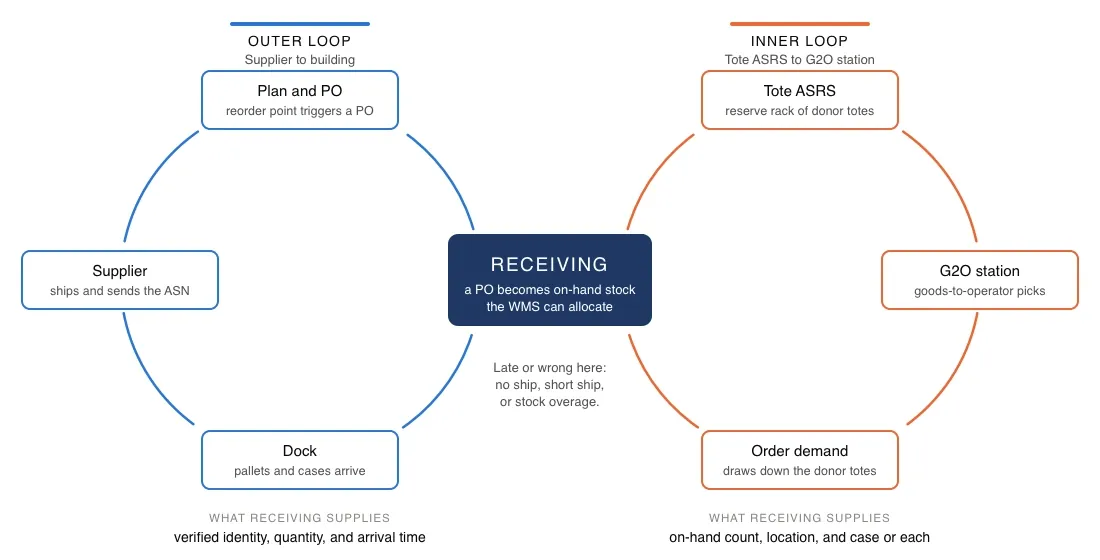
Inventory replenishment, also called stock replenishment, is the process of restoring stock to its target level. In a distribution center it runs as two loops. The outer loop moves product from suppliers into the building, driven by purchase orders and advance shipping notices (ASNs).The inner loop keeps a tote-based ASRS stocked. Inventory from receiving or from the reserve rack, which sits outside the ASRS, is decanted into donor totes before it enters, because the ASRS stores totes, not cases waiting to be decanted. Donor totes are the storage totes that hold the stock to be picked. Full cases can be stored in the same ASRS, but they generally leave as full cases. The ASRS brings donor totes forward to G2O stations, where an operator picks from the donor tote into the order. Maximum on-hand inventory levels set the ASRS sizing model. Min/max levels or order demand trigger replenishment.The common inventory replenishment methods are min/max, reorder point, periodic review, demand-based and top-off optimization. Min/max triggers a refill when on-hand stock falls to a minimum. Reorder point triggers one when stock covers only the demand expected during supplier lead time. Periodic review checks stock at fixed intervals and refills to a target level.Demand-based replenishment follows historical demand patterns or open orders. Top-off refills a pick location to full. Each of these inventory replenishment models decides when to replenish stock, and each one reads the on-hand count that receiving posts. A late or wrong count throws off all of them.Receiving is the hinge between the two loops. The outer loop closes when a purchase order becomes physical on-hand inventory. Once the WMS has stock it can allocate, the inner loop opens. As our warehouse receiving automation guide explains, every downstream process, including warehouse replenishment, inherits the errors, delays, and damage introduced at receiving.
Loop
Trigger
What moves
What receiving supplies
Outer loop: supplier to building
Purchase order, ASN, reorder point
Pallets and cases
Verified identity, quantity, and arrival time
Inner loop: tote ASRS to G2O station
Min/max level, order demand
Cases, decanted donor totes, eaches
On-hand count, location, and presentation (case or each)
Replenishment in warehouse operations is therefore a chain, not a single task, and the first link is receiving.When that link is weak, the inner loop fails in two directions. The WMS cannot see stock that receiving has not confirmed, so the ASRS has no donor tote to bring forward. At the G2O station there is nothing to pick, and the order ships short or does not ship. Or procurement, unable to trust the count, over-orders to guarantee on-hand inventory, and the surplus overstocks the reserve rack.Figure 1. The outer loop brings stock from suppliers to the dock. The inner loop keeps the tote-based ASRS stocked and brings donor totes forward to G2O stations. Receiving sits on both. When receiving is late or wrong, the result is a no ship, a short ship, or stock overage. Stock overages are cost overages. They create financial and operational problems that cascade.
Why does manual receiving stall warehouse replenishment?
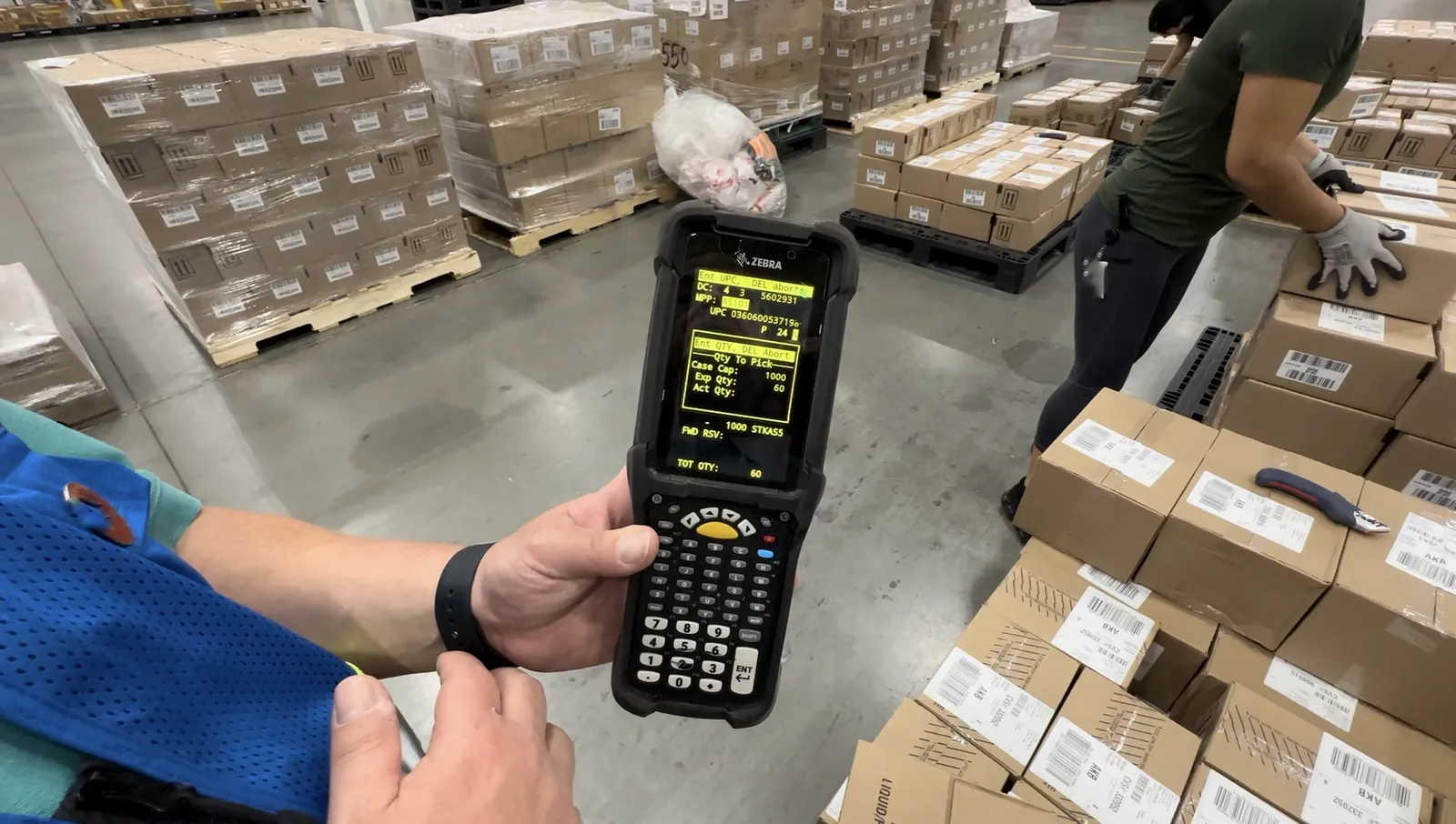
In a mixed inbound pallet example, manual receiving stalls replenishment because it can hold up the whole pallet for its slowest case, then posts the receipt in a batch at the end of the shift.Manual receiving at the dock laydown area starts with a handheld scan gun that has a small read-only screen and a cramped keyboard. The operator moves around each pallet, reads each purchase order line off that screen, matches it to the case, counts, and keys the quantity. Any case with a missing, damaged, or mismatched label gets double- and triple-handled: scanned, set aside, rescanned, then checked against paperwork.Accuracy is essential because replenishment engines act on the record. Every hand-keyed receipt adds another error chance for the record and the stock to part ways.The larger problem is mechanical. In this example, the mixed pallet is received as a unit, so all of its inventory waits for the slowest case on it. One unreadable label holds up the whole pallet’s receipt into the WMS, including the faster-moving SKUs that must wait with it.This is one workflow example of how manual receiving can bottleneck: a single case, or a few, stops the whole flow of cases, often compounded by a batch update that does not post until the end of the shift. The WMS shows zero available while product sits on the dock. This is how manual bottlenecks become a primary cause of “delay to stock”.A tote-based ASRS sharpens the point. The WMS sends a G2O pick only for stock the record says is in a donor tote. When the record shows zero stock for an item, the WMS releases no pick at all. If the record inaccurately states the tote inventory, the operator finds the donor tote short of the quantity required.
What does automated inbound receiving change before replenishment starts?
Automated inbound receiving replaces the scan gun and the batch job with four connected stages, each writing to the system as it happens:
Dock scheduling and unloading. ASN data sequences trucks and assigns doors, so the system knows what is arriving before it arrives.
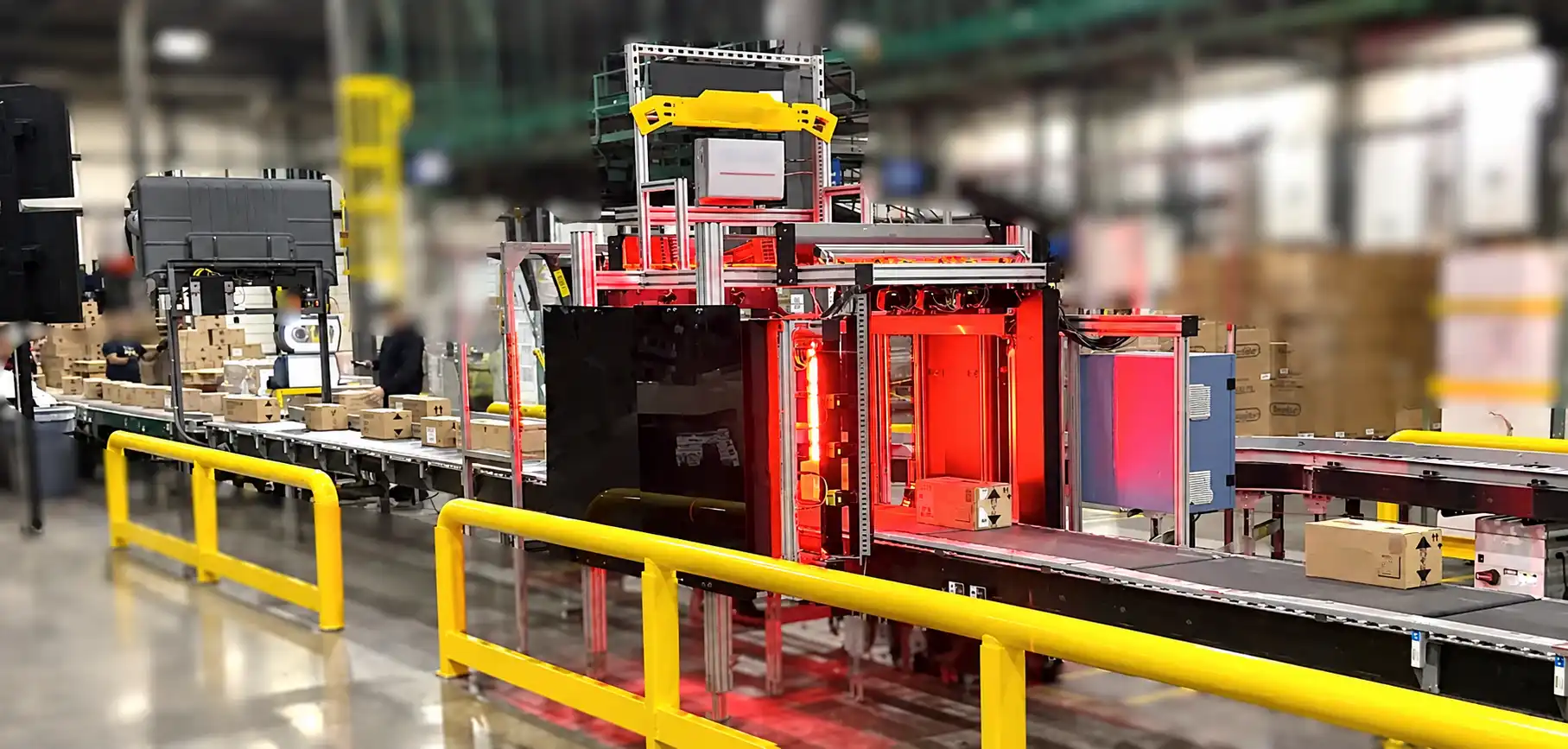
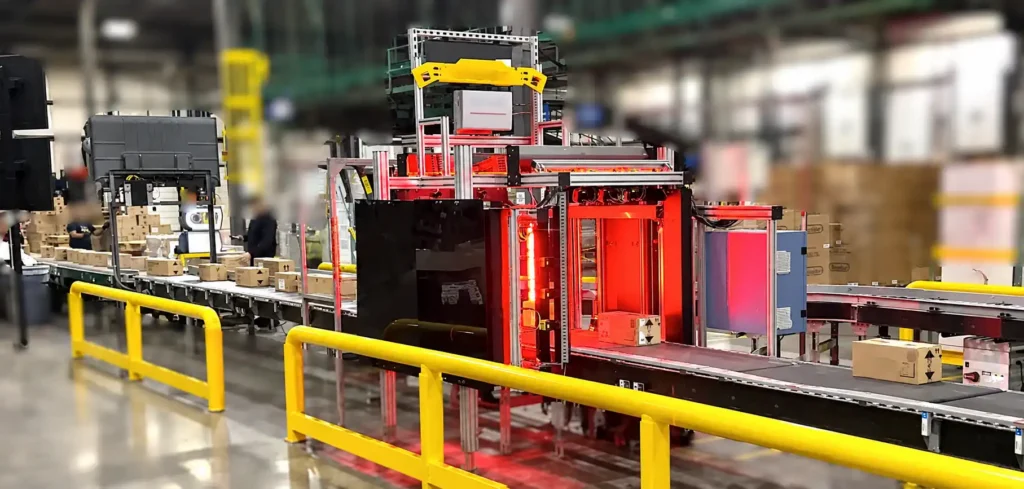
Scan and identification: AIDC. An omnidirectional scan tunnel reads GS1-128, UPC, ITF-14, QR, and SSCC barcodes and captures case dimensions and weight at conveyor speed. The system also typically applies a license plate number (LPN) label to supplement the outer vendor label. If the vendor label is a no read or is missing, the system diverts the case to an operator reconcile station for identification and LPN application.
Routing and allocation. Based on system logic, each case goes to storage, decanting, cross-docking, or an exception or value-added services (VAS) station.
Putaway and inventory update. The WMS and ERP receive the update through a real-time API when the case is confirmed, not through a batch file.
Scan and inventory update become a single event, so on-hand reflects arrivals within minutes rather than after the shift ends. That is the change replenishment feels first.Automation does not mean every case skips a person. Eligible cases move at full automated speed. Cases with no-read labels, new items, or quantity mismatches go to a reconcile or teach-in station. The ineligible cases range from 5% to 15% for automated box opening, largely from inbound transit damage and a small percentage from box design or materials (e.g., staples), and from 15% to 45% for automated decant, based on product category. Many cosmetics and other health and beauty aids have shrink-wrapped inner packs that only operators can separate, and some may require inspection.These cases run semi-automated: the box opener can still open the case, and an operator decants it at an ergonomic workstation. That station has a scanner, a full-size touch screen monitor, and a complete keyboard. Case, purchase order line, and exception reason sit on one screen, not behind a scan gun’s small display. Staffing matters here too. According to the 2026 MHI Annual Industry Report, 58% of the supply chain professionals surveyed rate talent acquisition and workforce challenges as a major challenge, up 9 points from last year. The report also ranks the workforce and talent shortage as the number 2 trend affecting supply chains. Automation moves valuable operators to ergonomic workstations integrated with it, where they can perform with higher efficiency and accuracy, based on Fitts’s law.
What does accurate efficient receiving change downstream in the warehouse?
Accurate receiving reaches six functions. The table shows what each one inherits from manual receiving and what changes when receiving is automated.
Downstream function
With manual receiving
With automated receiving
Putaway and slotting
Cases wait for late batch receipt upload, and item master dimensions and Global Trade Item Numbers (GTINs) are not included or verified
Dimensions, weight, and GTIN data captured and verified at the scan tunnel and can update the item master and direct putaway
Replenishment
Triggers fire against a stale on-hand count that sits on a dock waiting to be slotted
Tasks release against verified stock received within minutes and inventory moves off dock
Order fulfillment
Donor totes can have inaccurate inventory at the G2O station, so orders ship short or do not ship
Decanted, LPN-tracked donor totes have verified inventory levels in the ASRS before the pick releases
Tote ASRS and G2O stations
Induction flow is uneven and either starves or bottlenecks on mixed flow, taking up significant dock space, while G2O stations may wait for inbound replenished donor totes
A balanced and consistent, identified feed of totes keeps the ASRS and G2O stations performing to design. Dock space and staging are minimized and do not bottleneck
Inventory control and procurement
More cycle-count corrections as receipt errors compound, and procurement over-orders to compensate with no tracking or visibility of on-hand inventory at receiving
Fewer discrepancies, with exceptions logged where they occur for vendor compliance, so procurement can place orders using real on-hand inventory
Finance
Receipt posts late and inaccurate, so accruals and vendor payment lag, and chargebacks are frequent and protracted, with no compliance standards or metrics captured
Receipt confirmation can trigger the three-way match and vendor payment in real time and provide accurate vendor compliance reports from authenticated data capture and standards
The finance row is where operations and accounting meet. A verified receipt ties a dock event directly to cash timing, and it only works when the receipt data is right the first time.
Why does decanting decide whether received stock is ready for replenishment?
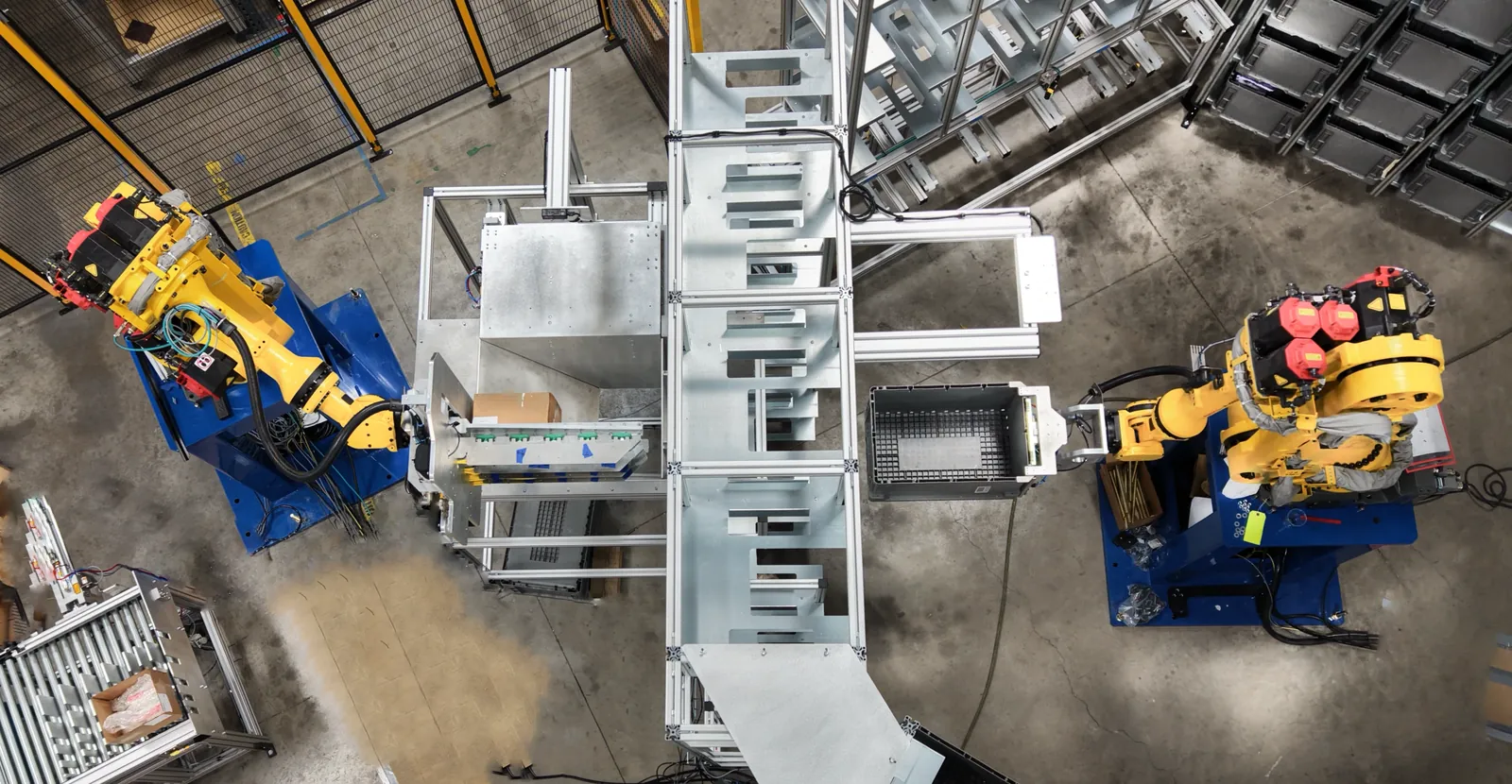
Received is not the same as replenishable. A G2O station in a break-pack operation can only pick from donor totes holding eaches or inner packs, not from a corrugated master pack that has been received but not decanted and replenished to the donor tote. This is where Decant Automation Systems connect to receiving as the next inbound step. In health and beauty aids (HBA), health and beauty care (HBC), and OTC distribution, where SKU counts are high and unit sizes are small, decanting is the step that makes each-level or item-level replenishment possible. For the demand side of that shift, see why automated box opening and decanting are becoming essential.In the ADDRIS inbound receiving platform, the scan tunnel identifies, weighs, dimensions, and labels each case. Eligible cases go to automated box opening, then to a robotic or operator station for decanting. A robotic put wall consolidates the contents into totes. The LPN manifest transfers to the WMS, and each tote is tracked until the ASRS stores it.That sequence lets the ASRS bring donor totes to G2O stations holding stock that is already identified, counted, and in the right container. It also follows a software-first rule: plan the WCS, WMS, and equipment together. A robot cell that cannot report what it opened and decanted leaves a blind spot in the replenishment record, just the same as an operator-based workstation would.ADDRIS is rated at 850 boxes per hour across two shifts, with $3.6M in annual labor savings and a 15-month return on capital investment. Additional ROI savings are determined separately as part of the business model analysis that is performed on each system.Decanting is also the largest single source of labor savings. Net of cases that route to operator stations, ADDRIS saves $0.536 to $0.758 in direct labor per case. Decant with tote consolidation accounts for $0.270 to $0.476 of that, more than half.
Decant is the largest source of ADDRIS labor savings
Direct labor savings per case by module, in US dollars. The four modules total $0.536 to $0.758 per case.
Low estimate
Range up to high estimate
ADDRIS direct labor savings per case by module, in US dollars, net of cases routed to operator stations
Module
Low estimate
High estimate
Decant with tote consolidation
$0.270
$0.476
Box open
$0.136
$0.152
Depalletize
$0.097
$0.097
Scan and label
$0.033
$0.033
Total, four modules
$0.536
$0.758
Healthcare and workers’ compensation cost reduction estimated at 16 to 23% of direct labor savings, based on HR-provided loss-prevention data across end-user facilities. Range varies by company size, product dimensions, throughput, insurance underwriter, and state jurisdiction. Each organization should supply its own figure through HR and its insurance underwriter for project-level analysis.
Basis: per case at a fully burdened labor rate of $27.50 per hour, net of cases that route to operator stations. Direct labor only, before residual operators and the annual service contract. Source: Decant Automation labor savings model, October 2026.
Figure 2. ADDRIS direct labor savings per case by module, net of cases routed to operator stations, at $27.50 per hour fully burdened. Source: Decant Automation labor savings model, October 2026.
How do you measure whether receiving is limiting replenishment?
Five measurements show whether the constraint sits at the dock or at the G2O station, before anyone retunes min/max levels:
Dock-to-stock time as a distribution, not an average. The slowest case sets the pallet’s time, so the tail matters more than the mean.
Receipt accuracy. The share of receipts later corrected by a cycle count or an inventory adjustment.
Replenishment task latency. The time from a replenishment trigger to product in a donor tote, split between stock on hand and stock still on the dock.
No-picks, short ships, and overage. G2O picks that fail or ship short while stock existed on site, plus reserve rack stock that demand will not use because procurement over-ordered.
Automation-eligible share. The percentage of cases eligible for automated opening and decanting, and the share routed to semi-automated or reconcile stations.
If the first and fourth numbers run high, tuning replenishment parameters will not fix the problem. The delay is upstream, in receiving.
How does faster receiving lower inventory carrying cost?
Faster, more accurate receiving lowers carrying cost because procurement can hold a smaller buffer against uncertainty.Safety stock, or buffer stock, exists to cover uncertainty, including uncertainty about when and how accurately inbound stock becomes available. Operations hold it to avoid stockouts.When receiving is slow and its record is unreliable, procurement over-orders to guarantee on-hand inventory, and the surplus overstocks the reserve rack. That is stock overage, or excess stock, and every unit of it is inventory carried.Carrying cost, also called holding cost, is the sum of the capital, storage, service, and risk costs of holding that inventory. Cut the buffer without fixing the record, and the uncertainty comes back as no-picks and short ships at the G2O station. Accurate receiving lets a facility maintain optimal stock levels with less buffer.On a national scale, that cost is large. As noted at the top of this article, the 2026 CSCMP State of Logistics Report, based on 2025 data, put inventory carrying costs at 30.4% of total U.S. business logistics cost. In 2024 the share was 30.2%. Receiving automation targets the buffer procurement holds against inaccurate receiving.In the validated benchmark, two Fortune 10 operators saw $5.8M in annual savings per facility against a $2.5M system cost. That was at 35 million cases opened per year, with a 15.7% gain in overall inbound throughput. The ROI for this system included labor with healthcare ergonomic costs only. The system design was a streamlined AIDC scan data capture and automated box opening with operator stations for decant. A design study with business model is required for each operation’s service levels and SKU mix, to validate all annual savings for receiving automation in addition to labor and healthcare.
What should you check before automating receiving for replenishment?
Three questions from the receiving guide decide the design:
Volume and SKU mix. These set conveyor, scan tunnel, dimensioning capacity and automation eligibility.
WMS and ERP integration. The receipt must post through a real-time API, because a batch file transfer recreates the delay you are removing.
Cross-docking and decanting needs. Pre-allocated orders and break-pack demand change the routing logic.
Add one more for any operation with a tote-based ASRS downstream: confirm receiving can hand the storage system identified, tote-ready product. A G2O station can only pick what receiving put in the donor tote, and procurement can only order against a count receiving got right.
Start with a receiving-to-replenishment design study
Decant Automation provides design studies that map your dock-to-stock flow to your WMS, WCS, and ERP, with the software stack and equipment designed together for optimizing inventory replenishment. Bring your dock-to-stock distribution and your replenishment trigger data, and we will show you where the constraint resides.
MHI, 2026 MHI Annual Industry Report, Rewiring the Future: A Supply Chain Playbook for Innovation. Figure 3 (page 6): talent acquisition and workforce challenges, 58% rated a major challenge, up 9 points from last year. Page 7: workforce and talent shortage ranked the number 2 trend. Survey of more than 500 supply chain professionals. https://www.mhi.org/annual-industry-reports
Decant Automation, ADDRIS Labor Savings Model 4 (October 2026): direct labor savings per case by module, net of cases routed to operator stations, at a fully burdened labor rate of $27.50 per hour. Healthcare and workers’ compensation cost reduction estimated at 16 to 23% of direct labor savings, based on HR-provided loss-prevention data across end-user facilities. Range varies by company size, product dimensions, throughput, insurance underwriter, and state jurisdiction. Each organization should supply its own figure through HR and its insurance underwriter for project-level analysis.
Decant Automation, receiving automation benchmark: $5.8M annual savings per facility, $2.5M system cost, 35 million cases per year, 15.7% overall inbound throughput gain. Validated by two Fortune 10 retail and e-commerce operators (names confidential). Figures published on the Warehouse Receiving Automation page.
Decant Automation, case eligibility for automated box opening 5% to 15% and decant 15% to 45%. These vary across industry type and category applications from retail, ecommerce, electrical and the 3PLs that support them. All automated decanting systems require operator stations for a percentage of processing for no-read or damaged labels, missing labels, teach-in of new SKUs, QC spot checks, damaged cases, and inner pack dunnage.
Tim Robertson is the Solution Architect and Subject Matter Expert behind Decant Automation, a division of DAC Robotics. Across 30-plus years, from ASRS and storage design at Interlake to e-commerce DC design at Dematic to running his own omni-channel operation, he has architected warehouses end to end, from inbound receiving and decanting through ASRS fulfillment and outbound sortation. A biomechanics background from York University informs his ergonomic workstation design.
Related Resources
Inventory Replenishment Starts at the Receiving Dock
Inventory replenishment is only as fast and accurate as the receiving dock that feeds it. In a tote-based ASRS, warehouse replenishment can only move stock that receiving has scanned, verified